
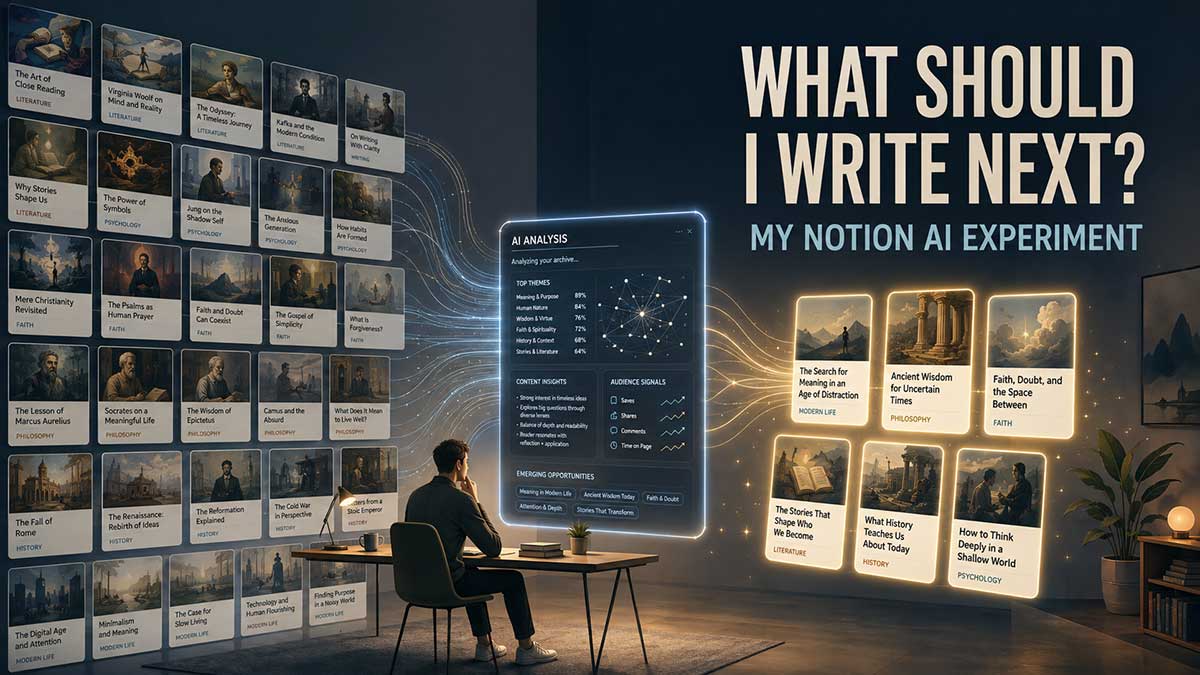
Note: I’m documenting the Notion AI workflow I’m currently setting up for ImaginaryTalks.com. Some examples below illustrate the type of results I expect from the experiment. I’ll update this article with screenshots and actual results once my full content library is inside Notion.
There is a question almost every serious content creator eventually asks:
What should I publish next?
It sounds simple.
It isn't.
When you're new to blogging, your problem may be finding enough ideas. After you've published dozens or hundreds of articles, the problem changes.
You have too many possible directions.
That is where I became interested in Notion AI.
I run ImaginaryTalks.com, a site built around imaginary conversations involving authors, historical figures, fictional characters, thinkers, scholars, spiritual questions, psychology, philosophy, literature, and modern life.
One book can lead me to five or ten possible projects.
I might begin with a conversation between characters.
Then I may bring scholars together to discuss the same work.
That can inspire a modern short story.
Then another article emerges from one emotional theme inside that story.
Before long, one idea has become an entire family of content.
I wasn't looking for another AI that could give me 100 random blog ideas.
I wanted something different.
I wanted to see whether I could place my existing content inside Notion and ask:
“Look at what I've already created. What should I do next?”
That is the experiment behind this Notion AI review.
Why I Wanted to Test Notion AI on a Real Website
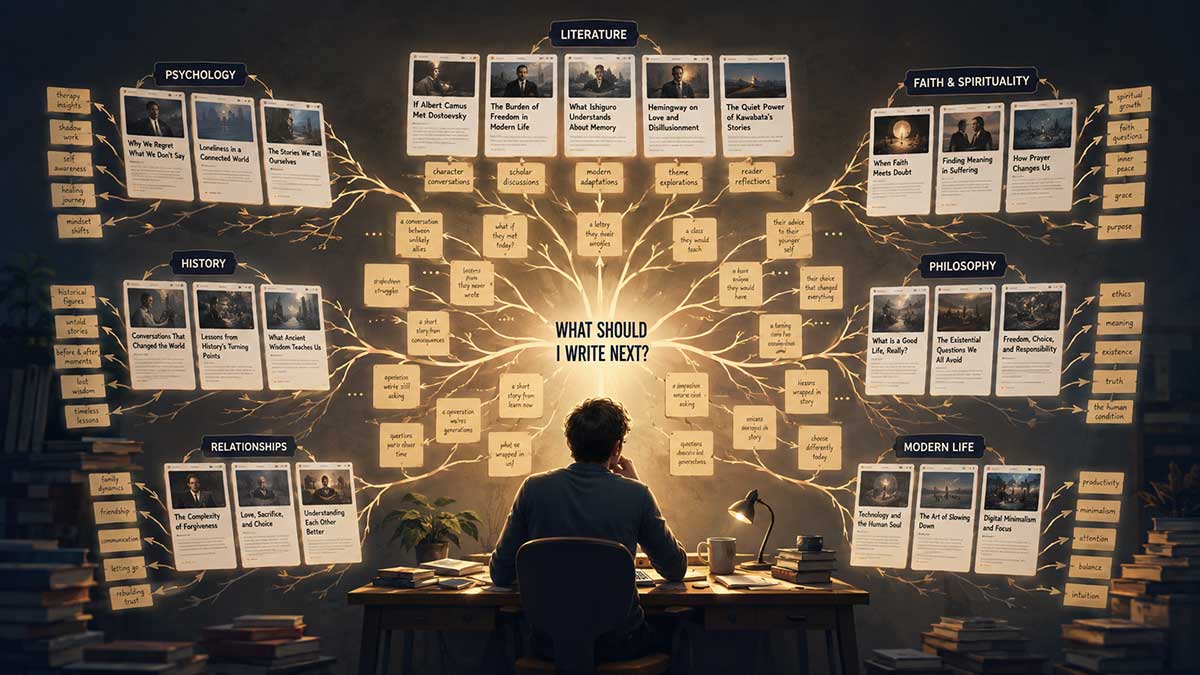
AI brainstorming is easy.
You can ask almost any modern AI system:
Give me 50 blog post ideas about literature.
Within seconds, you'll receive a list.
The problem is that most of those ideas know very little about you.
They don't necessarily know:
- what you've already published,
- which writers you've covered,
- which themes keep appearing in your work,
- which series are unfinished,
- which articles naturally belong together,
- or which interesting gaps exist inside your archive.
That was what interested me about Notion AI.
Notion's current AI tools can use information stored in your workspace as context. Notion says its Agent can search and analyze content across the workspace, work with databases, and create or edit pages using that context. (Notion)
That suggested a different use case.
Instead of asking AI:
“What should I write about?”
I could ask:
“Given everything I've already written, what should I write about next?”
That extra context changes the question.
My goal isn't more ideas
I already have more ideas than I can publish.
My goal is to find better next ideas.
There is a big difference.
If you run a blog, YouTube channel, newsletter, podcast, research project, or content business, you may recognize the problem.
You have:
30 articles.
Then 100.
Then 300.
Each new piece creates possible follow-ups.
At some point, your existing archive itself becomes a source of future ideas.
The challenge is seeing them.
How I'm Setting Up My ImaginaryTalks Content in Notion
The first stage is fairly simple.
I don't need to create an incredibly complicated system.
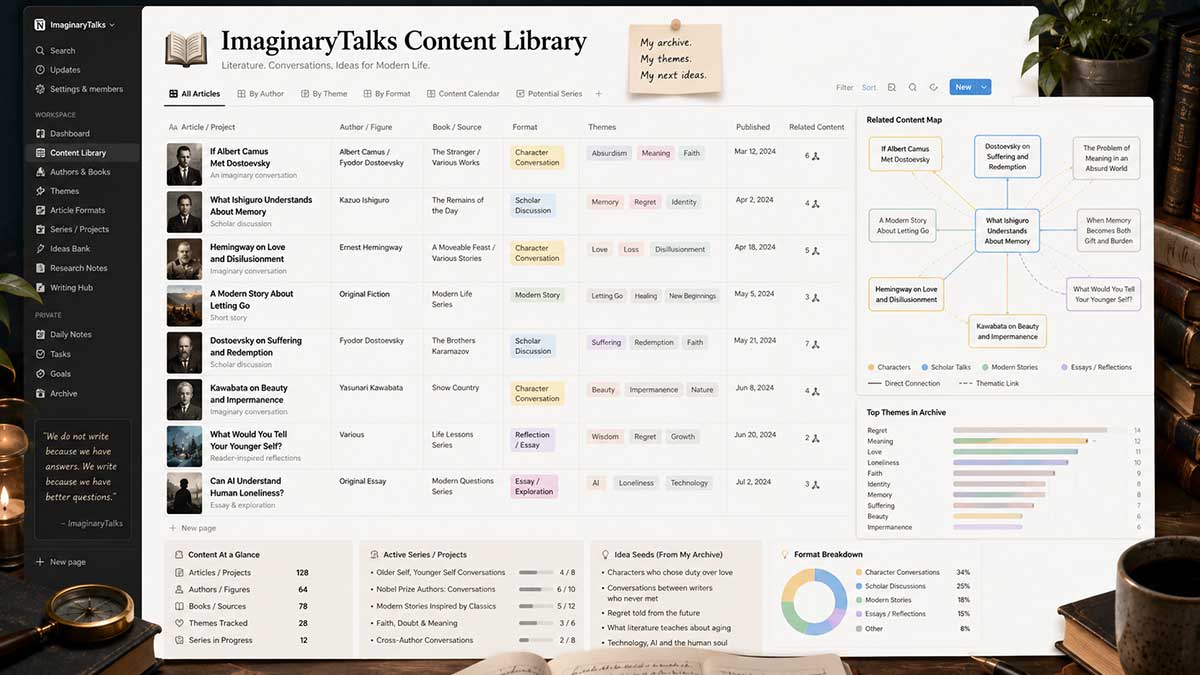
I want each ImaginaryTalks article to become an entry inside a Notion database.
Notion databases let you attach properties such as URLs, dates, categories, status information, and other context to each item. (Notion)
For my experiment, I would use fields such as:
Article title
The published headline.
URL
The live ImaginaryTalks page.
Person or author
For example:
Albert Camus
Kazuo Ishiguro
Ernest Hemingway
Fyodor Dostoevsky
Book
When the project is based on a particular work.
Content format
Such as:
- Character conversation
- Scholar conversation
- Modern story
- Historical conversation
- Spiritual discussion
- Psychological discussion
Main themes
For example:
Regret
Loneliness
Faith
Meaning
Forgiveness
Mortality
Duty
Memory
Love
Identity
Related articles
This is where things begin getting interesting.
A character conversation about a novel might be connected with:
- a scholar discussion,
- a modern story,
- another author exploring the same issue,
- or a future article that hasn't been written yet.
Notion gives me a place to see those relationships together rather than viewing everything as separate WordPress posts.
Getting existing webpages into Notion
Notion has a Web Clipper that can save webpages into a workspace, and it supports imports from several common file formats. (Notion)
For a large archive, I would probably use a structured import rather than manually clipping hundreds of pages one by one.
For the initial experiment, though, I don't need everything.
Thirty to fifty representative ImaginaryTalks articles should be enough to learn whether this idea has real value.
The First Question I Want to Ask Notion AI
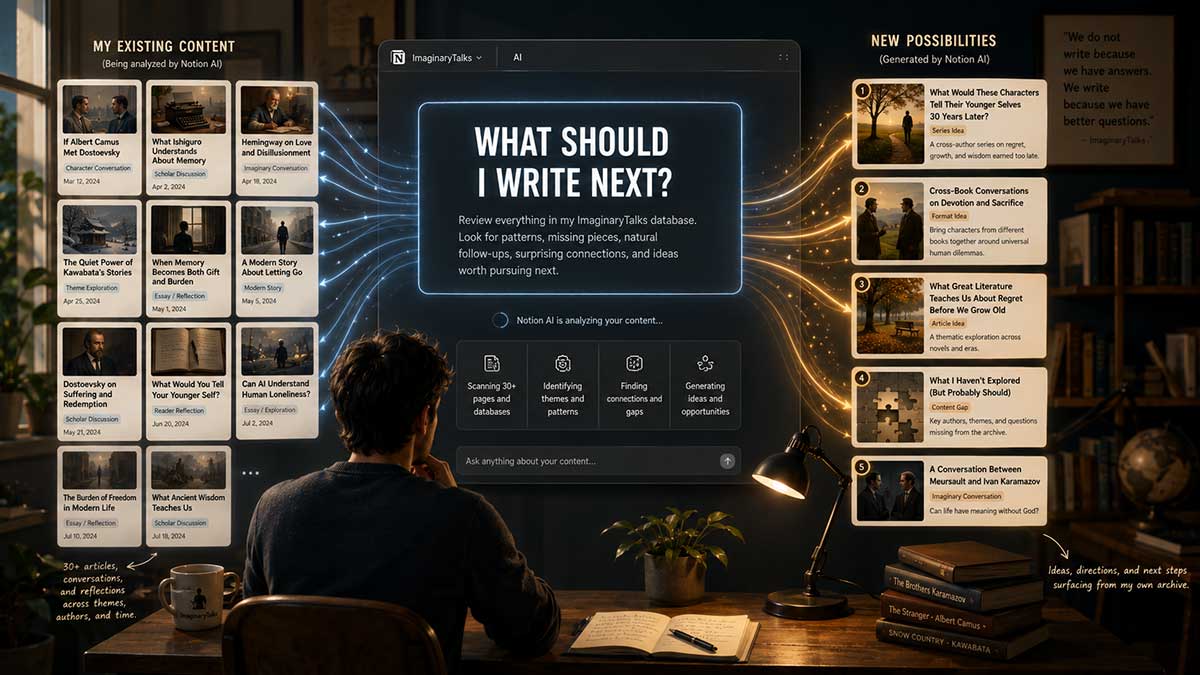
Once the content is inside Notion, I want to ask one very simple question:
Review my ImaginaryTalks content. Based on the authors, books, themes, article formats, and subjects I've already explored, what should I publish next? Look for natural follow-ups, missing pieces, unexpected connections, and ideas that could become a series.
I don't want:
50 generic article ideas.
I want Notion AI to look for clues inside the work I've already done.
Here is the kind of result I expect.
Result #1: Finding Follow-Up Articles Hidden Inside Existing Content
Suppose Notion looks at my literature projects.
It might notice that one book can appear in several forms.
For example:
Original novel
↓
Imaginary conversation between its characters
↓
Conversation among scholars
↓
Modern story inspired by its themes
That immediately creates a useful question:
Which books have one or two parts completed, but still have another strong direction left unexplored?
That is different from brainstorming.
The idea is already sitting inside my archive.
I simply haven't acted on it yet.
A possible Notion AI suggestion
Imagine Notion sees several projects involving characters who carry regret for decades.
It might suggest:
“Create a series where major literary characters speak to their younger selves 30 years later.”
Now that interests me.
I could explore:
- what they regret,
- what they misunderstood,
- what they would do differently,
- which sacrifices were worth making,
- which ones weren't.
That isn't simply another article.
It could become a recurring ImaginaryTalks format.
And it came from examining patterns across material I've already created.
Why this matters to me
This is where I think Notion AI could become useful for publishers.
I don't need AI to replace my imagination.
I want it to show me opportunities inside my own body of work that I may not have been actively looking for.
Want to try this with your own archive?
If you already have a collection of articles, research, videos, or notes, you can put them into Notion and ask AI what directions it sees.
[Try Notion AI and See What It Finds in Your Content →]
Affiliate disclosure: If you sign up through links in this article, I may receive a commission at no extra cost to you.
Result #2: Finding Themes I Keep Returning To
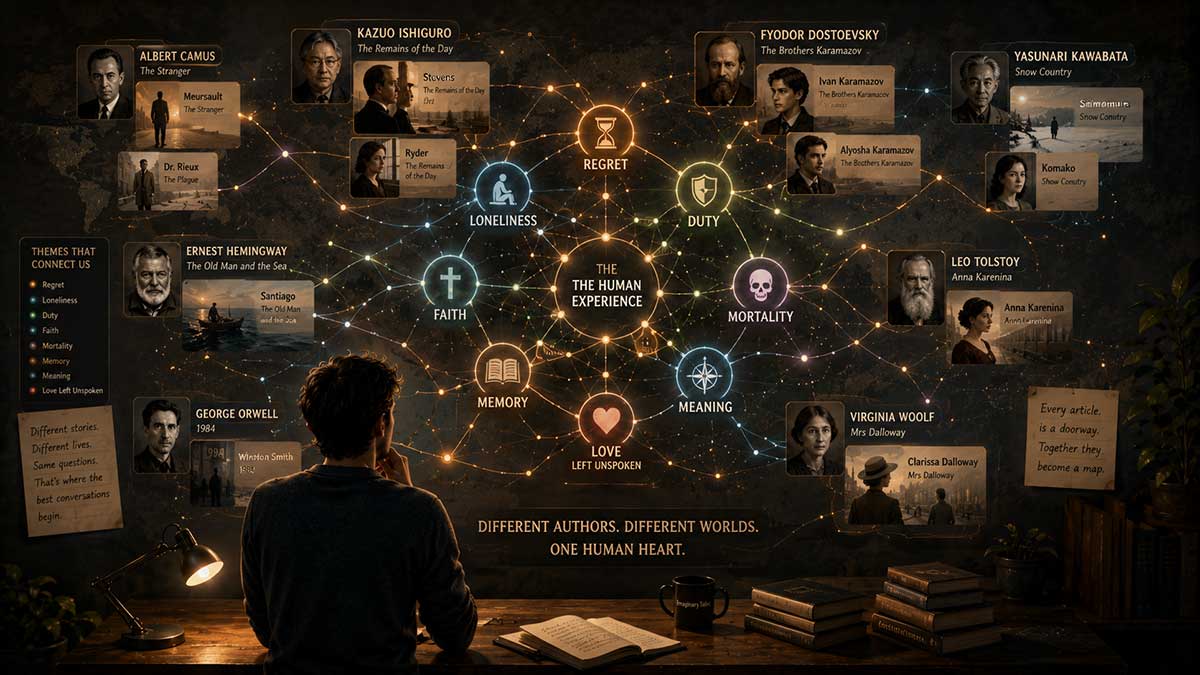
This may be one of the most interesting parts of the experiment.
A creator often knows what individual articles are about.
What may be harder to see is what the entire body of work is about.
Suppose Notion looks across my work involving writers such as Camus, Ishiguro, Hemingway, Dostoevsky, and Kawabata.
It might notice repeating ideas:
Regret
People realize late in life what they failed to say or do.
Duty
Characters sacrifice personal happiness for responsibility.
Loneliness
People want connection but struggle to reach one another.
Meaning
Characters confront questions about whether suffering has purpose.
Mortality
Age and death change the meaning of earlier choices.
Faith
Belief becomes most interesting when certainty disappears.
Now I can ask:
“Which emotional themes appear across several unrelated authors?”
That can produce a new type of article.
For example:
What Great Literature Teaches Us About Regret Before We Grow Old
That isn't tied to one book.
It connects several parts of the archive.
The old content becomes research for a new piece.
Result #3: Finding Connections Between Writers Who Never Met
This possibility excites me more.
ImaginaryTalks is built around conversations that could never happen in ordinary life.
Once my articles are categorized inside Notion, I can ask:
“Find characters from different books who struggled with similar questions.”
Suppose Notion identifies Stevens from The Remains of the Day and Santiago from The Old Man and the Sea.
Both men understand devotion.
Both sacrifice.
Both measure themselves against a demanding idea of dignity.
That leads to a fascinating imaginary conversation:
Was Devotion Worth What It Cost You?
Now suppose Notion finds Meursault from The Stranger and Ivan Karamazov from The Brothers Karamazov.
That could become:
Can Life Have Meaning Without God?
This is where using my archive becomes very different from staring at a list of WordPress posts.
The posts stop looking isolated.
They start creating conversations with one another.
Result #4: Finding What Is Missing
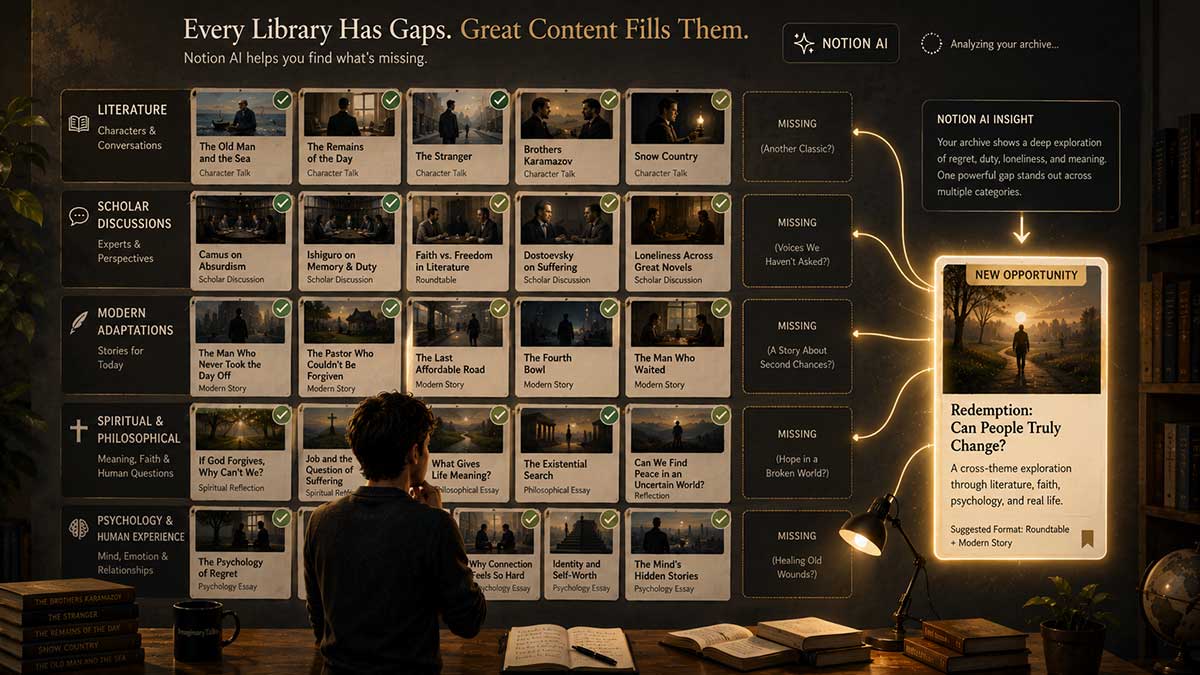
Creators often ask AI:
“What should I create?”
I think another question may be more useful:
“What am I missing?”
For example:
“Which major writers fit the themes of ImaginaryTalks but receive little or no attention in my current database?”
Or:
“Which emotional subjects appear often in my modern stories but rarely in my scholar discussions?”
Or:
“Which novels received a character conversation but never became a modern adaptation?”
Now AI is performing something closer to editorial gap analysis.
That could lead to an article I wouldn't have chosen through ordinary brainstorming.
Gaps can be more useful than ideas
There is no shortage of AI-generated ideas.
Ask for 100 and you'll get 100.
The scarce thing is judgment.
Which idea belongs next?
Which subject fits what you've already built?
Which missing piece would make the existing archive richer?
Those are much more interesting questions.
Result #5: Connecting Subjects I Usually Treat Separately
ImaginaryTalks isn't limited to classic literature.
Themes cross into:
Psychology.
Religion.
Spirituality.
Technology.
Relationships.
History.
Aging.
Meaning.
Modern life.
If those subjects are tagged properly, I can ask Notion AI to find unusual intersections.
Here are a few examples of what that might produce.
Literature + psychology
What Would Modern Therapy Tell Literature's Most Troubled Characters?
Literature + AI
What Would Dostoevsky Think About Artificial Intelligence?
Faith + regret
If God Forgives Us, Why Can't We Forgive Ourselves?
Aging + literature
What Great Novels Tell Us Only After We Grow Older
Technology + loneliness
Can AI Companionship Make Loneliness Better—or Deeper?
I may never publish some of these.
That's fine.
The goal isn't to accept every suggestion.
The goal is to uncover possibilities worth thinking about.
I Would Ask Notion AI for 20 Ideas—But I Wouldn't Expect 20 Winners
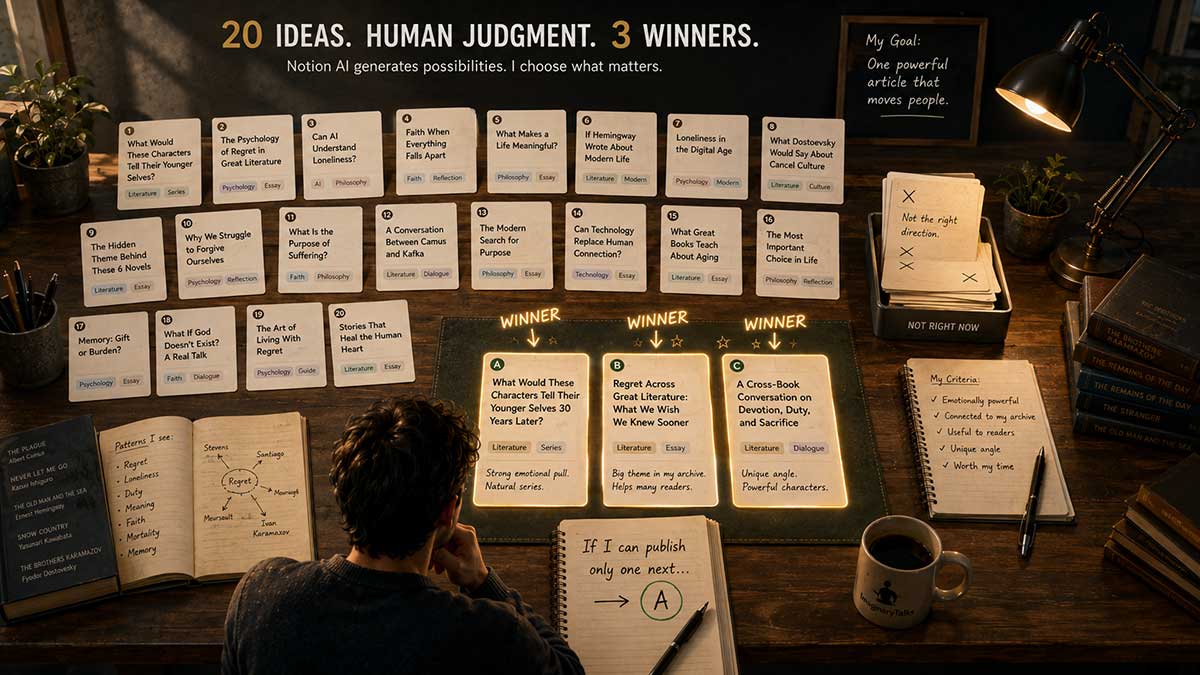
This is where I want this review to stay realistic.
If Notion AI gives me 20 article ideas, I don't expect every idea to be brilliant.
My likely reaction would look more like this:
Several ideas: obvious.
Several: interesting, but wrong for ImaginaryTalks.
A few: worth saving.
Maybe three or four: ideas that make me want to start writing.
And that's enough.
If one AI session gives me three genuinely interesting editorial directions, I consider that useful.
I don't need twenty winners.
I need one next project.
The prompt I would use
Review all content in this database and propose 20 new ImaginaryTalks articles. Do not repeat existing topics. Prioritize ideas that connect existing articles, complete unfinished content families, reveal missing subjects, or combine themes I've previously explored separately.
Then I would follow with:
Choose the five strongest ideas and explain why each one fits my existing body of work.
And finally:
If I can publish only one of these tomorrow, which one would you choose?
That last question is probably the one I care about most.
If you want to try the same process:
[Check Out Notion AI and Ask It What You Should Create Next →]
The Most Useful AI Prompt May Be “Which Idea Should I Reject?”
There is another experiment I want to try.
Instead of asking AI to create more, I want to ask it to eliminate.
For example:
“Here are ten article ideas I'm considering. Based on my existing ImaginaryTalks archive, rank them from strongest to weakest. Tell me which three I should probably skip.”
That changes the role of AI.
It is no longer an idea machine.
It becomes a second editorial opinion.
I still make the final decision.
Yet having something examine dozens of earlier projects before giving that opinion could be useful.
Five Notion AI Prompts I Would Start With
If you're experimenting with this yourself, these are the prompts I'd copy first.
1. Find my next article
Review my existing content and recommend five articles I should create next. Explain how each idea connects to something I've already published.
2. Find content gaps
What meaningful subjects, questions, or perspectives are missing from my current archive?
3. Find hidden series
Which existing articles could naturally become three-part or five-part content series?
4. Find unusual connections
Identify five surprising connections between subjects I've previously covered separately. Turn each connection into a possible article.
5. Pick one
If I can publish only one new article next, which idea would you select based on my existing content, and why?
These prompts cost almost nothing to test once your material is in the workspace.
Notion's Agent is currently able to search workspace material and use that context when working with pages and databases, which is what makes this experiment possible. (Notion)
What I Think Notion AI Will Do Well
My expectations are fairly focused.
Looking across many pieces at once
I can read one article and see its opportunities.
AI may help when I want to examine 30, 50, or 100 articles together.
Finding repeated themes
Patterns become easier to see when content is categorized in one place.
Finding incomplete sequences
Character discussion completed.
Scholar discussion completed.
Modern adaptation missing.
That is an actionable observation.
Creating editorial questions
The best output may not be an article title.
It may be a question I hadn't thought about asking.
What I Don't Expect Notion AI to Do for Me
I don't expect it to become the creative voice behind ImaginaryTalks.
I don't want that.
I still want to decide:
- which conversations matter,
- which ideas move me,
- which stories deserve to exist,
- which questions feel emotionally real.
AI suggestions still need human taste.
Some will probably be generic.
Some may misunderstand what makes ImaginaryTalks different.
Some may sound technically relevant but leave me emotionally cold.
That doesn't make the experiment unsuccessful.
I wouldn't hire a human editor expecting to follow every suggestion either.
I want a second perspective.
Notion AI vs. ChatGPT: Why I Would Use Both
I don't see this as a choice between Notion AI and ChatGPT.
They solve different parts of my workflow.
Where I use ChatGPT
ChatGPT is where I develop ideas.
I can explore a book.
Question its characters.
Create an imaginary discussion.
Develop a modern adaptation.
Work through themes.
Shape a long article.
Rewrite.
Research.
Think creatively.
Where Notion AI becomes interesting
Notion has another advantage.
The content itself can live inside the workspace.
Its Agent can use workspace context and work with pages and databases. (Notion)
That makes it attractive for questions such as:
What haven't I covered?
Which pieces belong together?
What series is incomplete?
Which theme deserves another article?
What should I publish next?
My ideal workflow looks like this:
Published content → Notion → AI analysis → promising direction → my judgment → ChatGPT creative development → new ImaginaryTalks article
Then the new article eventually returns to the Notion database.
The library gets richer.
The next analysis gets more context.
Would I Pay for Notion AI for This?
Yes, I would pay for it if the experiment works the way I expect.
I am not approaching Notion from the position of someone trying to organize ten notes.
I want to use it around a growing archive of serious content.
If I can ask questions across that archive and receive useful editorial directions, that has real value to me.
The calculation would be different for someone who has published only a handful of posts.
If you have five articles, you can probably look at them yourself and see nearly every connection.
If you have 50, 100, 500, or more pieces spread across years of work, the idea becomes far more interesting.
The archive becomes large enough that useful patterns can hide in plain sight.
That's the point where I would test Notion
If you've already invested months or years creating content, I think it's worth seeing whether AI can help you get more value from what you've already built.
[Try Notion AI With Your Own Content →]
Who I Think Should Try This Experiment
This isn't limited to bloggers.
Bloggers
Put your article library into Notion and ask what you should write next.
YouTubers
Store video topics, transcripts, themes, and performance notes.
Then ask:
“Which subjects deserve follow-up videos?”
Newsletter publishers
Look for recurring reader problems and unfinished series.
Authors
Store research, characters, themes, scenes, essays, and notes.
Ask what relationships emerge.
Affiliate marketers
Compare published buying guides, tutorials, reviews, and keywords.
Look for gaps around topics already producing results.
Researchers
Connect notes across papers and projects.
Notion's current AI offering is built around workspace search, writing, databases, research, and AI agents rather than functioning only as a text generator. (Notion)
That broader workspace context is the reason this use case interests me.
Is Notion AI Worth It for Content Creators?
Here is the question I would use.
Do you need another AI writer?
If that's all you want, there are many AI tools to compare.
But ask a different question:
Do you have a valuable archive that you want AI to help you think across?
That is more interesting.
Your old articles contain:
ideas you abandoned,
questions you never followed,
series you didn't finish,
subjects you treated separately,
people who should be placed in conversation,
and themes you may have repeated without realizing how central they had become.
I don't want Notion AI to manufacture my next idea from nowhere.
I want it to help me see what my existing work is already pointing to.
My Early Verdict: The Result I'm Looking For Isn't 100 Ideas
The experiment begins with:
“What should I write next?”
But I don't think the ideal result is a giant list.
The ideal result is something much smaller.
Maybe Notion AI looks through my ImaginaryTalks archive and finds five directions.
I reject two immediately.
Two are interesting.
One makes me stop.
That one becomes my next project.
Perhaps it notices how frequently my stories return to regret and suggests:
What Would Literature's Most Regretful Characters Tell Their Younger Selves?
Maybe it discovers that characters from unrelated novels are confronting the same problem.
That produces a cross-book imaginary conversation.
Maybe it identifies a subject I've almost completely ignored.
That sends ImaginaryTalks in a direction I wasn't expecting.
Any of those outcomes would make the experiment worthwhile to me.
The best AI result isn't necessarily:
“Here is more content.”
It may simply be:
“Look over here. You haven't noticed this yet.”
And for someone who already has a large collection of work, that can be extremely valuable.
If you have your own archive of articles, videos, newsletters, research, or creative projects, you can run the same experiment.
Put a representative sample inside Notion.
Ask what it sees.
Ask what's missing.
Ask what connects.
Ask what deserves a sequel.
Then ask the hardest question:
“If I create only one thing next, what should it be?”
You may disagree with the answer.
You may ignore most of the suggestions.
But you may find one idea hiding inside your own work that you never would have noticed otherwise.
[Try Notion AI and See What It Finds →]

Leave a Reply