

What if you could build your own $100,000 education without paying $100,000?
That number isn't just clickbait.
For the 2026–27 academic year, Harvard estimates its total undergraduate cost of attendance at $95,134 to $100,134, before required health insurance for students who aren't otherwise covered. Princeton estimates $94,624 for first-year and sophomore students before variable transportation costs.
Of course, that doesn't mean every student actually pays close to $100,000. Financial aid can substantially reduce the real price, and an elite university provides things ChatGPT cannot reproduce: respected credentials, exceptional professors, classmates, laboratories, research opportunities, alumni networks, campus experiences, and human relationships.
But forget the degree for a moment.
Suppose your objective is simply this:
Become exceptionally good at something.
What would you need?
A curriculum.
A great teacher.
Questions that expose what you don't understand.
Practice.
Feedback.
Real projects.
Mistakes.
Correction.
Difficult decisions.
Repeated testing.
And eventually, the judgment that normally comes from experience.
AI can now help with a surprising number of those things.
Yet most people use ChatGPT very differently.
They ask a question.
ChatGPT produces a polished answer.
They read it.
They think, “That makes sense.”
Then they move on.
That's useful for finding information.
But it may be one of the least interesting ways to use AI for serious learning.
The seven ChatGPT prompts below take the opposite approach.
Instead of asking AI to make learning effortless, we're going to make it demand more from you.
We're going to turn ChatGPT into your curriculum designer, private professor, oral examiner, apprenticeship supervisor, experience simulator, decision simulator, and long-term mastery coach.
Think of it as building your own $100K ChatGPT curriculum, one learning system at a time.
Why Most People Learn With ChatGPT the Wrong Way
AI has made answers extraordinarily easy to obtain.
That can create a strange problem.
Suppose you're studying economics and ask ChatGPT:
“Explain opportunity cost.”
It gives you a beautifully clear explanation.
You read it and think:
“Yes. I get it.”
Now close the answer.
Explain opportunity cost to a 12-year-old.
Identify it inside a complicated business decision.
Distinguish it from sunk cost.
Then solve a new problem involving both concepts.
Suddenly, “I understand” means something different.
The Difference Between Recognition and Mastery
Educational research gives us good reason to care about this distinction.
A major meta-analysis covering 122 experiments found that testing and retrieval practice can help learning transfer into new situations, including application and inference problems.
This points to a much more interesting way to use ChatGPT.
Don't constantly make AI retrieve information for you.
Make AI force you to retrieve it.
Don't ask:
“Do I understand this?”
Give ChatGPT a stronger instruction:
Don't ask whether I understand. Make me demonstrate it.
That principle is built into all seven prompts below.
These aren't merely seven clever questions to ask ChatGPT.
They're seven different learning systems.
Prompt #1: The $100K Curriculum

Suppose you type:
“I want to master artificial intelligence.”
Where should you start?
Python?
Linear algebra?
Machine learning?
Neural networks?
Transformers?
APIs?
AI agents?
The first difficulty in mastering a huge subject is often figuring out what belongs where.
A beginner may not know what matters, what can wait, what depends on something else, or what should come first.
That's what The $100K Curriculum is meant to solve.
It turns ChatGPT into your curriculum architect.
Copy This Prompt: The $100K Curriculum
I want to master [SUBJECT] at the level of an exceptional graduate from a top university, without enrolling in a degree program.
Act as my curriculum architect, professor, tutor, and examiner.
Start by interviewing me to determine my current knowledge, experience, goals, available study time, preferred learning methods, and how I intend to use this knowledge.
Then build a personalized curriculum progressing from fundamentals to advanced competence.
Use high-quality books, textbooks, free university courses, lectures, research papers, case studies, exercises, simulations, and real-world projects where appropriate.
Identify the small number of concepts and skills responsible for a large share of practical competence and give them extra attention without ignoring essential foundations.
For each stage:
- Teach the core concepts.
- Give me examples.
- Make me retrieve the ideas without looking at the explanation.
- Make me apply them.
- Test my knowledge.
- Identify weaknesses in my reasoning.
- Give me corrective exercises.
- Retest me using a different problem.
- Do not advance me until I demonstrate mastery.
Periodically test earlier material without warning.
Do not mistake recognition or memorization for competence.
Give me unfamiliar problems requiring me to transfer what I learned into new situations.
Maintain a running record of my strengths, weaknesses, misconceptions, and mastery.
Modify the curriculum according to my performance.
My objective isn't to finish a curriculum. My objective is to become exceptionally competent at [SUBJECT].
Begin by interviewing me.
Ask one question at a time.
Why This ChatGPT Learning Prompt Works Differently
The valuable part isn't simply the reading list.
You can get a reading list from ChatGPT in seconds.
The real value is the loop:
Learn → Retrieve → Apply → Fail → Correct → Retest → Advance
Say two people both want to master digital marketing.
One has spent 15 years writing sales copy.
The other has never sold anything.
Giving them identical curricula makes little sense.
The diagnostic interview lets ChatGPT establish where you are before mapping where you should go.
Nick's Tip
Don't skip the interview.
Answer the diagnostic questions seriously. The better ChatGPT understands your starting point and destination, the more useful the curriculum can become.
Prompt #2: The Private Professor

Prompt #1 decides what you should learn.
Prompt #2 changes how you're taught.
This isn't far removed from the direction AI learning tools are already taking.
ChatGPT's Study Mode can ask guiding questions, explain concepts step by step, check comprehension, provide feedback, and quiz you one question at a time rather than simply producing final answers.
Our Private Professor prompt pushes that idea further.
Copy This Prompt: The Private Professor
Become my private professor in [SUBJECT].
Your objective is to make me capable of thinking independently about this subject rather than remembering your explanations.
Begin with a diagnostic examination.
Ask questions of increasing difficulty until you can identify the boundary between:
- what I truly understand
- what I partially understand
- what I merely recognize
- what I incorrectly believe I understand
- what I don't know
Then teach me one major concept at a time.
For each concept:
- Explain it from first principles.
- Explain why it matters.
- Give me a simple example.
- Give me a real-world example.
- Show me common misunderstandings.
- Connect it to knowledge I already possess.
- Ask me to explain it back without copying your wording.
- Give me a problem requiring application.
- Challenge my reasoning.
- Change the context and test me again.
Use Socratic questioning frequently.
When my reasoning is weak, don't immediately reveal the answer. Ask questions that help me locate the flaw myself.
Return to earlier concepts periodically without warning.
Do not praise answers merely for sounding plausible. Tell me precisely what is correct, incomplete, confused, or incorrect.
Consider a concept mastered only when I can explain it simply, recognize when it applies, use it correctly, distinguish it from related ideas, defend my reasoning, and teach it to another person.
Keep track of my recurring weaknesses and misconceptions.
Begin the diagnostic examination now.
Ask one question at a time.
Make ChatGPT Stop Rescuing You
This may be one of the most valuable changes you can make to an AI tutor.
AI is extraordinarily good at rescuing us.
We struggle for five seconds.
We ask for help.
The answer appears.
A good teacher can sometimes do something more valuable:
Give you just enough help to keep thinking.
If your reasoning goes wrong, the Private Professor might respond:
“What assumption are you making?”
Or:
“Would your conclusion remain true if I changed this variable?”
Now you have to find the problem.
The struggle can become part of the education.
Nick's Tip
Keep “Ask one question at a time” in the prompt.
Without it, an AI tutor can turn what should feel like private instruction into a giant worksheet.
Prompt #3: The 10-Year Experience Compressor
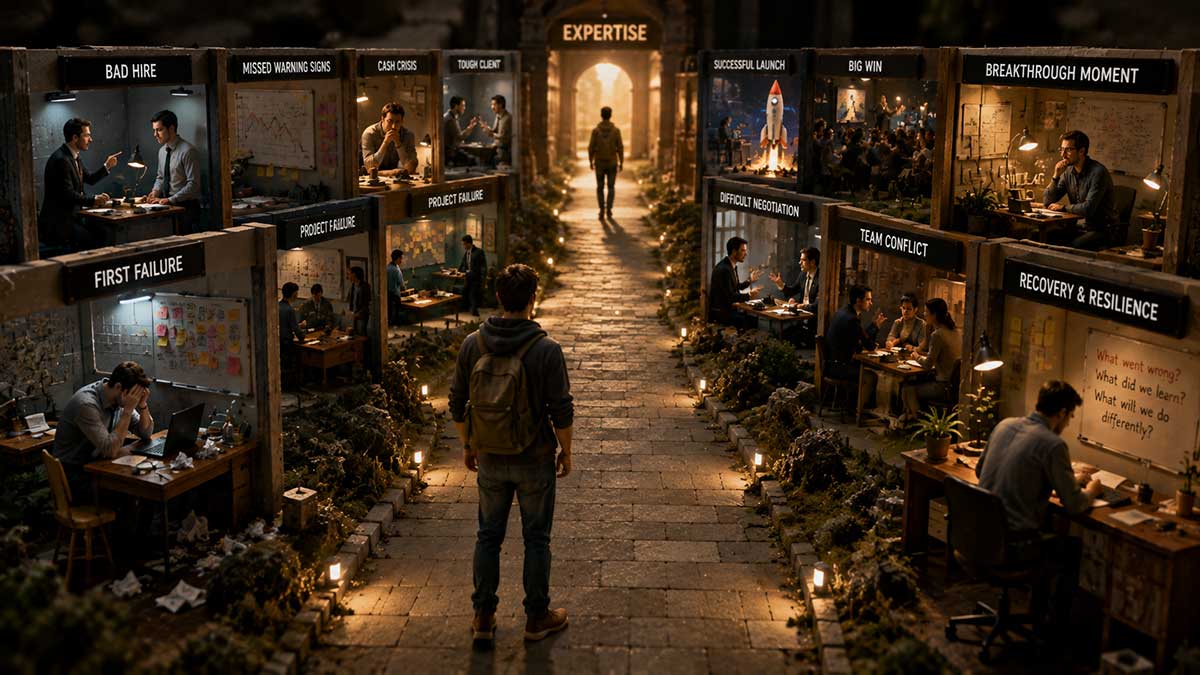
This is one of my favorite prompts in the entire collection.
Ten years of experience isn't valuable simply because ten years passed.
Think about what happened during those years.
Someone made hundreds or thousands of decisions.
They watched projects fail.
They trusted the wrong people.
They overlooked warning signs.
They discovered shortcuts.
They made expensive mistakes.
They encountered unusual situations.
They saw seemingly unrelated problems reveal the same underlying pattern.
Eventually, they began seeing things a beginner couldn't see.
Can ChatGPT literally give you 10 years of experience?
No.
But could AI expose you to far more scenarios, mistakes, trade-offs, and decisions than passive study?
That's much more plausible.
Copy This Prompt: The 10-Year Experience Compressor
I want to become exceptional at [SKILL].
Help me compress as much practical wisdom as possible from roughly 10 years of serious professional experience into an intensive simulation program.
Focus less on textbook information and more on what experienced practitioners learn from repeated real situations:
expensive mistakes, failed strategies, pattern recognition, judgment, timing, trade-offs, unwritten rules, hidden risks, edge cases, warning signs, opportunity recognition, difficult people, ambiguous situations, expert heuristics, and decisions made with incomplete information.
First map the progression from beginner to competent practitioner to expert.
Identify the experiences that tend to produce the biggest improvements in judgment.
Then turn those experiences into realistic scenarios.
Give me situations where information is incomplete and several choices appear reasonable.
Do not reveal the answer.
Require me to explain:
- What do I think is happening?
- Which information matters most?
- What might be misleading?
- What would I do?
- Why?
- What could go wrong?
- What information would change my decision?
After I commit to an answer, evaluate my reasoning from the perspective of an experienced practitioner.
Explain what I noticed, what I missed, which assumptions were dangerous, what patterns an expert might recognize, what inexperienced people commonly do, and what an experienced practitioner might do differently.
Track recurring weaknesses in my judgment.
Create later scenarios deliberately targeting those weaknesses.
Increase the ambiguity, stakes, and difficulty as my judgment improves.
Your objective isn't to make me feel successful.
Your objective is to improve my decisions.
Begin by identifying 10 valuable lessons practitioners in [SKILL] commonly learn the hard way.
Use AI to Practice Experience, Not Just Facts
Try this ChatGPT prompt with entrepreneurship, sales, management, SEO, real estate, copywriting, programming, or negotiation.
Don't ask:
“What are five rules of negotiation?”
Let the AI put you inside a simulated negotiation.
Halfway through, the other party changes the terms.
New information arrives.
Your best option suddenly looks worse.
Now decide.
Afterward, let AI dissect your reasoning.
That moves learning closer to practice.
Prompt #4: The Knowledge Gap Destroyer
The most dangerous knowledge gap isn't:
“I don't know.”
It's:
“I already know that.”
Familiarity can feel like competence.
The Knowledge Gap Destroyer takes away ChatGPT's friendly lecturer role and turns it into a demanding oral examiner.
Copy This Prompt: The Knowledge Gap Destroyer
Interview me rigorously about [SUBJECT] until you expose what I think I understand but actually don't.
Ask one question at a time.
Begin broadly, then follow my answers wherever weaknesses appear.
Look for:
- factual gaps
- conceptual gaps
- incorrect assumptions
- shallow memorization
- confused terminology
- contradictions
- inability to apply concepts
- inability to explain causes
- inability to predict consequences
- overconfidence
- knowledge that collapses when circumstances change
When I use vague language, require precision.
Challenge my claims with questions such as:
Why?
How do you know?
What mechanism produces that result?
What evidence would change your conclusion?
What happens if this variable changes?
Can you give me a concrete example?
Can you explain that without using the terminology you just used?
After the diagnostic phase, create my Knowledge Gap Map.
Classify gaps as:
CRITICAL: likely to cause major errors or block deeper learning
HIGH: materially weakens competence
MEDIUM: important knowledge that needs strengthening
LOW: refinement or specialist knowledge
Then address gaps in priority order.
For each gap:
- Show me what I misunderstood.
- Teach the missing idea.
- Give me an example.
- Make me explain it back.
- Test it in a familiar situation.
- Test it in an unfamiliar situation.
- Test it again later without warning.
Never mark a gap resolved merely because I can repeat your explanation.
A gap disappears only when I can reason correctly with the knowledge independently.
Maintain and update my Knowledge Gap Map.
Begin with one deceptively simple diagnostic question.
Try This on Something You Think You Already Know
Don't necessarily start with a new subject.
Try your profession.
Try the skill you've practiced for 15 years.
Try the subject everyone comes to you for advice about.
Then let ChatGPT keep asking:
Why?
How?
What evidence supports that?
What happens when this changes?
Give me an example.
That's when this prompt becomes fascinating.
Nick's Tip
Ask ChatGPT to separate missing knowledge from faulty knowledge.
Not knowing something can be easier to correct than confidently believing something incorrect.
Prompt #5: The Real-World MBA
You can read 50 books about entrepreneurship without building a business.
You can watch 100 copywriting tutorials without writing a sales page.
You can study SEO for six months without ranking a page.
At some point, education has to become execution.
Research on project-based learning supports the value of learning through meaningful projects. A meta-analysis examining 66 experimental and quasi-experimental studies reported positive effects on academic achievement, thinking skills, and attitudes.
Our fifth prompt applies that principle aggressively.
Stop asking ChatGPT to lecture you.
Make it give you work.
Copy This Prompt: The Real-World MBA
Teach me [BUSINESS OR CAREER FIELD] primarily through execution rather than lectures.
Treat this as an apprenticeship.
Create 10 projects of increasing difficulty resembling work professionals in this field actually get paid to perform.
Each project should require several abilities such as research, analysis, judgment, prioritization, problem solving, communication, creation, decision-making, and defending recommendations.
Introduce realistic constraints when useful:
limited budgets, deadlines, incomplete information, conflicting objectives, competitors, difficult clients, unexpected setbacks, changing conditions, and ethical dilemmas.
For every project provide:
THE BRIEF
Give me the situation, objective, constraints, and deliverables.
THE WORK
Require me to produce the assignment rather than describe what I would do.
THE DEFENSE
Challenge my assumptions and require me to defend major decisions.
THE GRADE
Score the work from 0–100 against professional standards, including reasoning, execution, communication, practicality, originality where relevant, and risk awareness.
THE EXPERT REVIEW
Explain what an experienced practitioner would notice that I missed.
THE REVISION
Require me to improve weak sections.
Set the progression threshold at 85/100.
If I score below 85, require revision before advancing.
If I repeatedly struggle with one ability, create a smaller targeted exercise before continuing.
Projects 1–4 should develop practical foundations.
Projects 5–7 should introduce ambiguity and competing priorities.
Projects 8–9 should resemble senior-level work.
Project 10 should be a capstone where I independently solve a difficult real-world problem from beginning to end and defend my decisions.
Do not show me an expert solution until after I submit my own work.
Begin by asking what outcome I want from [FIELD].
Make AI Grade You, Not Congratulate You
Most of us enjoy reading:
“Excellent work!”
But improvement sometimes requires:
“Your recommendation isn't supported by your evidence.”
“You ignored the largest risk.”
“Your numbers don't justify the conclusion.”
“Your proposed solution doesn't meet the client's constraint.”
“Revise it.”
The objective isn't a pleasant score.
It's better work.
Nick's Tip
Never let ChatGPT show you the model answer before you submit yours.
Once you've seen the solution, you've changed the exercise from creation into recognition.
Prompt #6: The Expert Simulation Engine

Information has become cheap.
Judgment remains expensive.
Real problems rarely arrive like exam questions.
They don't tell you:
“Here are the five relevant facts.”
Some information is missing.
Some information is useless.
People change their minds.
Deadlines appear.
Incentives conflict.
Two reasonable solutions may point in opposite directions.
Sometimes every available option has a downside.
This creates one of the most interesting possibilities for AI learning:
Decision simulation.
Copy This Prompt: The Expert Simulation Engine
I want to develop expert-level judgment in [FIELD OR SKILL].
Create an ongoing series of realistic decision simulations based on situations experienced practitioners encounter.
Do not make them clean textbook problems.
Include incomplete information, uncertainty, competing priorities, realistic distractions, hidden risks, and occasionally irrelevant information.
Present one scenario at a time.
Do not tell me what lesson the scenario is testing.
Do not reveal the expert approach until I commit to a decision.
Require me to state:
- my interpretation of the situation
- the facts I consider important
- information I believe is irrelevant
- assumptions I'm making
- my decision
- why I chose it
- major risks
- what could change my mind
After I commit, critique my reasoning.
Compare my approach with several plausible approaches an experienced practitioner might consider.
Identify patterns, warning signs, second-order effects, and trade-offs I missed.
Keep a Decision Error Log containing recurring weaknesses in my thinking.
Use that log to design future scenarios.
As I improve, increase uncertainty, time pressure, conflicting incentives, and consequences.
Occasionally give me scenarios where the obvious answer is wrong.
Occasionally give me scenarios where there is no single correct answer.
Judge the quality of my reasoning, not merely whether my final choice matches yours.
Begin with a realistic intermediate-level scenario.
Turn ChatGPT Into a Flight Simulator for Decisions
Pilots use simulation partly so rare and dangerous situations don't have to be encountered for the first time in an actual aircraft.
AI gives us an intriguing intellectual version of this idea.
A manager can practice handling a key employee threatening to leave.
An entrepreneur can face a simulated cash crisis.
A marketer can diagnose a collapsing campaign.
A negotiator can confront an unexpected demand.
Make a decision.
See what you missed.
Reset.
Try again.
Nick's Tip
Keep the instruction about irrelevant information.
Learning to recognize what doesn't matter can be nearly as valuable as recognizing what does.
Prompt #7: The Mastery Loop

We've built the curriculum.
We've learned the concepts.
We've exposed knowledge gaps.
We've completed projects.
We've simulated experience.
We've practiced judgment.
One problem remains.
Forgetting.
Something can make perfect sense today and become surprisingly difficult to reproduce three months later.
That's why the final prompt creates a Mastery Ledger.
The Six Levels of Mastery
Instead of treating knowledge as binary, give each important concept six possible levels:
Unknown → Recognized → Understood → Applicable → Transferable → Mastered
This distinction matters.
Recognizing an answer isn't the same as producing it.
Explaining something isn't the same as applying it.
Applying something in a familiar situation isn't necessarily the same as transferring that knowledge into a completely new situation.
Copy This Prompt: The Mastery Loop
Create and maintain a Mastery Ledger for everything important I learn about [SUBJECT].
Classify each major concept at one of six levels:
UNKNOWN: I cannot explain it.
RECOGNIZED: It looks familiar when I see it.
UNDERSTOOD: I can explain it independently.
APPLICABLE: I can use it correctly in familiar situations.
TRANSFERABLE: I can use it in unfamiliar situations and combine it with other knowledge.
MASTERED: I can retrieve, explain, apply, adapt, critique, and teach it reliably over time.
Never promote a concept merely because I answered one question correctly.
Test important concepts repeatedly using different wording and contexts.
Periodically bring earlier concepts back without warning.
Require retrieval without notes whenever practical.
Use:
- explanation
- prediction
- application
- comparison
- error detection
- teaching
- unfamiliar problems
- mixed problems combining several concepts
Maintain a ledger containing:
Concept
Current mastery level
Evidence
Recurring weakness
Last test
Recommended next challenge
If my performance deteriorates, downgrade the mastery level.
Give greater testing frequency to weak or important concepts.
Reduce repetition for concepts I consistently demonstrate.
Periodically give me cumulative Mastery Checks combining old and new material.
Do not optimize for making me feel knowledgeable.
Optimize for durable, transferable competence.
Begin by creating the Mastery Ledger from what we've covered so far.
If there is no prior material in this conversation, ask what I want to master.
How to Combine All 7 ChatGPT Prompts Into Your Own AI University
This is where the system becomes much more interesting.
Don't treat these as seven unrelated ChatGPT prompts.
Connect them.
Step 1: The $100K Curriculum
What should I learn?
Build the roadmap.
Step 2: The Private Professor
Teach it to me.
Work through difficult concepts interactively.
Step 3: The Knowledge Gap Destroyer
What am I missing?
Expose weaknesses and false confidence.
Step 4: The Real-World MBA
Make me use it.
Turn knowledge into actual work.
Step 5: The 10-Year Experience Compressor
Show me what experience tends to teach.
Encounter mistakes, patterns, warning signs, and unusual situations.
Step 6: The Expert Simulation Engine
Make me decide when the answer isn't obvious.
Practice judgment under uncertainty.
Step 7: The Mastery Loop
Make sure I can still retrieve and use it later.
Keep testing until knowledge becomes durable and transferable.
Put together, the seven layers look like this:
Curriculum → Teaching → Diagnosis → Execution → Experience → Judgment → Mastery
Notice what's happening.
The better the system becomes, the less ChatGPT is doing your thinking for you.
That's intentional.
The One Instruction That Makes Almost Any ChatGPT Learning Prompt Better
If you take only one sentence from this article, make it this:
Don't ask whether I understand. Make me demonstrate it.
Ask ChatGPT to make you explain without notes.
Apply.
Compare.
Predict.
Find errors.
Defend decisions.
Teach ideas simply.
Solve unfamiliar problems.
Combine multiple concepts.
Then test the same knowledge later when you're no longer expecting it.
The easier AI makes access to information, the more valuable it may become to deliberately practice retrieving and using that information yourself.
What the Research on AI Tutors Actually Says
There's good reason to be excited about AI tutoring, but there's good reason to avoid exaggerated claims too.
The Encouraging Evidence
A 2025 randomized controlled trial involving college students compared a specially developed AI tutor with in-class active learning.
Students using the AI tutor learned more in less time in that particular experiment and reported higher engagement and motivation.
That's encouraging.
The Warning We Shouldn't Ignore
Newer evidence gives us an equally useful warning.
A 2026 NBER working paper reported results from a two-year experiment involving 18 Tennessee middle schools using Khan Academy with the AI tutor Khanmigo.
Assignment to the system produced modest math gains, but students didn't consistently engage in deep dialogue with the tutor.
The researchers identified engagement as a central limitation.
This distinction matters enormously.
Access to an AI tutor isn't the same thing as learning from an AI tutor.
That's one reason the seven prompts in this article repeatedly make the learner answer, retrieve, explain, decide, create, defend, and revise.
The goal isn't more AI output.
The goal is more human thinking.
Can ChatGPT Really Replace a $100K Education?
No.
And that's the wrong question.
What AI Cannot Reproduce
A Harvard, Princeton, or comparable university education includes things these prompts cannot provide:
human professors and mentors, classmates, credentials, laboratories, research opportunities, institutional resources, clubs, alumni relationships, campus life, and spontaneous human experiences.
Sticker price isn't the same as what every student pays either.
Need-based financial aid can greatly change the real cost.
Who Could Benefit From a $100K ChatGPT Curriculum?
Think about a different group.
The entrepreneur who wants to understand accounting.
The 45-year-old who wants to learn programming.
The marketer who finally wants to master statistics.
The manager who wants to become a skilled negotiator.
The retiree who has always wanted to study philosophy.
The student who wants to go far beyond the assigned curriculum.
For these learners, the interesting question isn't:
“Can ChatGPT give me a Harvard degree?”
It can't.
The more useful question is:
How much serious education can I build for myself when I have access to an AI that can explain, question, simulate, critique, test, and adapt whenever I want to learn?
That's a question worth experimenting with.
Your $100K ChatGPT Curriculum Can Start Tonight
Pick one thing you've wanted to learn for years.
Don't download 50 books tonight.
Don't subscribe to 12 courses.
Don't spend another evening watching videos about how someday you're going to learn it.
Open ChatGPT.
Start with The $100K Curriculum.
Replace [SUBJECT] with whatever you want to master.
Answer the diagnostic questions seriously.
Let ChatGPT build the curriculum.
Let it teach you.
Let it expose the holes in your knowledge.
Let it give you difficult work.
Let it criticize your decisions.
Let it bring back concepts you thought you knew.
Then use the other six prompts as you progress.
And the next time ChatGPT asks whether you understand something, don't say yes.
Prove it.

Leave a Reply